If the lines don’t look like lines, go to the OR
I told a room of hand surgeons in November that everyone should have an ultrasound in their pocket. I meant it.
The machines are not exotic anymore. You can carry one, you can put it on the nerve in clinic, and you can see whether the anatomy still looks like anatomy.
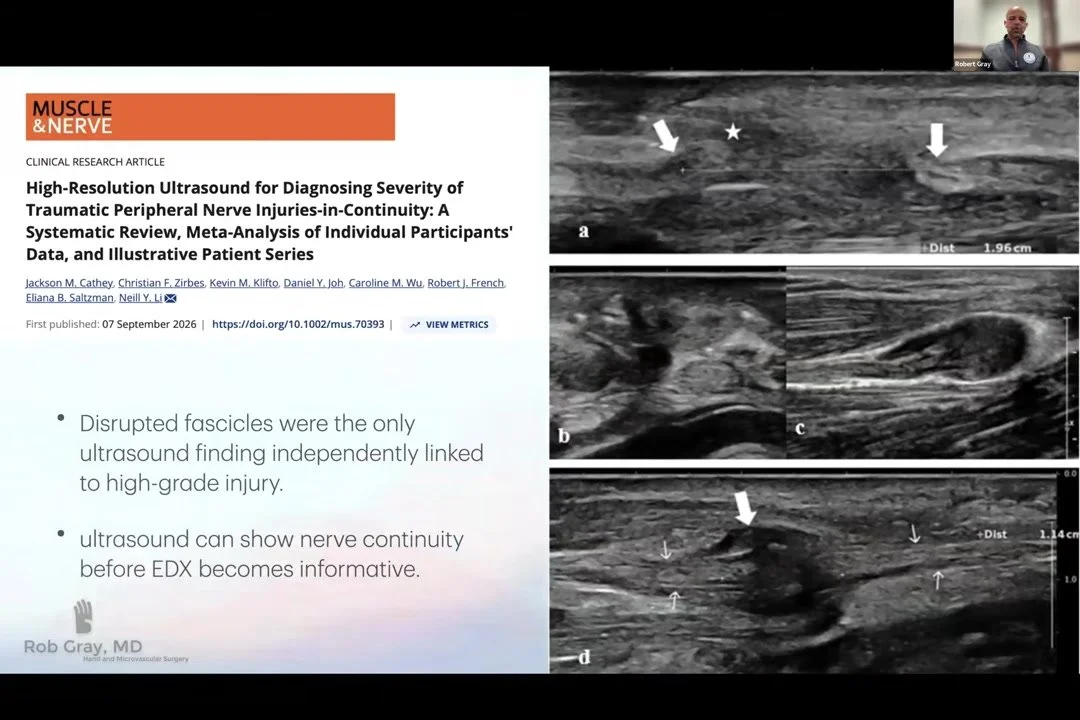
You do not have to be an ultrasonographer to get the useful information. A normal nerve has a pattern to it — lines, fascicles, a honeycomb if you are looking at it in cross section. When those lines stop looking like lines, or when a dark gap appears in the middle of the nerve, that is not a reason to order another test and wait. That is a reason to look in the operating room. Neurolyse it, repair it, do what the exploration requires. But if the lines don’t look like lines, go to the OR.
I am not arguing against electrodiagnostic testing. I am arguing against using it as a gate. Ultrasound can show continuity — or the loss of it — before an EDX study becomes informative. In a review I showed on the webinar, disrupted fascicles were the only ultrasound finding independently linked to high-grade injury. That matches what I see: the picture does not have to be fancy to be actionable.
The exam still comes first. There is no substitute for a knowledgeable set of hands on the patient, and these exams change over a week. Ultrasound is a way to look at the nerve the same day, in the same room, without waiting for a report that will not change the decision if the anatomy is already obviously wrong.
This is also why I do not want referring clinicians to hold a patient until every study is back. If you can feel that something is wrong, or if you can see that the nerve is no longer a nerve, the next step is a surgeon who will explore it. The study can run in parallel.
That does not mean every abnormal study needs an immediate operation. It means the decision belongs to a surgeon who has seen the nerve, on the image and in the exam, and who is willing to look when the picture is wrong. Waiting for a prettier study does not make a discontinuity grow back together.
I will keep saying this until it is ordinary: put the probe on the nerve. If the lines look like lines, you have information. If they don’t, stop wondering and look.
Watch this segment from the AAHS webinar Managing Nerve Injuries in 2026: How Treatment Decisions Have Evolved, November 17, 2026.