
The first step to fixing the people is finding the people
In November I spoke on an American Association for Hand Surgery webinar about how treatment decisions in nerve injury have changed. My title was “Making the Call.” The point was simpler than that.
The first step to fixing the people is finding the people.
Most of what a hand surgeon sees, a hand surgeon can handle. Some injuries need a plexus center or another kind of specialty care, and those still have to leave the office when they should. The duty does not change with the size of the practice. Document the exam. Decide who needs to move. Do not let a test become the ticket to be seen.
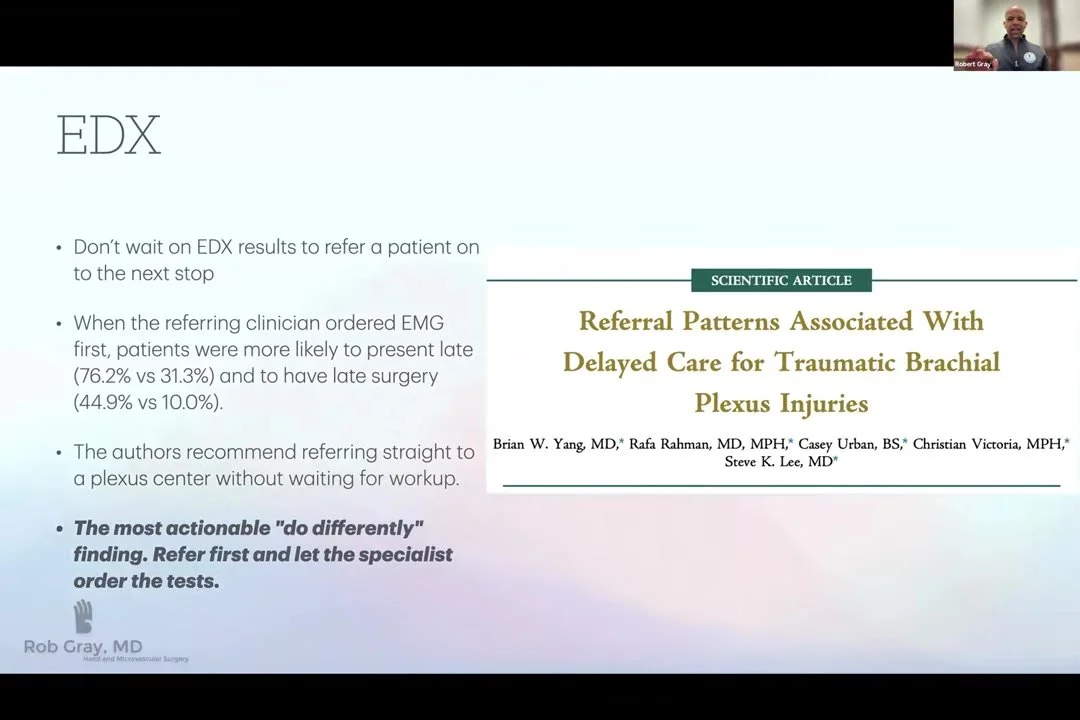
That last part is where we still lose time. If you are talking to a referring physician, or if you are the referring physician, and the patient is going on to a nerve or plexus center, order the electrodiagnostic study if it will help — but do not wait for the results before you place the referral. If you are not the person who will take that patient across the finish line, do not wait for the EDX to come back before you send them.
I showed a paper on delayed care after traumatic brachial plexus injury. When the referring clinician ordered the EMG first, patients were more likely to present late (76.2% vs 31.3%) and to have late surgery (44.9% vs 10.0%). The authors recommend referring to a plexus center without waiting for workup. That matches what I tell people: refer first, and let the specialist order the tests. They often want their own study anyway. Waiting for yours does not help.
What I actually need in the referral is not a stack of reports. I need to know when it happened, how it happened, and what the exam showed. “The hand isn’t moving” is not enough. That could be a laceration, a crush, carpal tunnel, or a stroke. Those are not the same emergency, and they do not belong in the same clinic slot.
Detail fades at every handoff. An emergency physician or an urgent-care clinician may not have the same nuance in a motor exam that a hand surgeon does. That is not a criticism. It is a reason to standardize the questions and to see the sharp injuries fast. Even if we later choose to watch a neurapraxia, the ones that have to go fast have to be sorted early. For a neurapraxia, it is still better for a nerve surgeon to watch the patient than for a non-nerve surgeon to watch the patient.
I built a Nerve Referral Kit on this site for that reason. It gives a referrer a straightforward way to send onset, mechanism, and exam, and it gives a health-IT team a starting list of diagnoses that should not wait — a cut hand with numbness, a nerve laceration, a foot drop that is not already in a spine clinic. The referral is placed when the diagnosis is entered, not after the study comes back.
Finding the people is the first operation. The repair comes after that.
Watch the talk from the AAHS webinar, Managing Nerve Injuries in 2026: How Treatment Decisions Have Evolved, November 17, 2026. The EDX point is at 16:13. The kit is at 21:49 and on the site at /nerve-referral.